Five months ago, I starting working in Springfield, IL as a
park guide at Lincoln Home NHS and haven’t had much time to go on any exciting
adventures. With no nearby mountains to climbs or rock faces to scale, I found
it difficult to adjust to my new urban environment. I now spend my free time playing disc golf
(Springfield has four 18-hole courses to choose from!), riding my brand new
bike along the bike path, working on my cardio endurance at the gym (gotta stay
in shape for future hiking trips), and when a friend’s softball team is down
one female, I fill the spot.
Earlier this month, I finally took some annual leave so I
could return to Wisconsin and be reunited with my family. The Grimme-Witter Family Reunion took place
on the first weekend of August and there was NO WAY that I was going to miss
it!
My Checklist for the family reunion weekend
Uncle Joe owns the family farm and for the past few years the farm has been
the location for the family reunion. Year after year, the reunion keeps getting
bigger and better.
A view of the reunion
As always, we took rides on the four wheeling trails, popped up tents, slept in campers, sat around the bonfire, and had Saturday night fireworks.
In addition to the standard activities, this year, we also had, a
wagon ride, horse rides, a bouncy house, and my favorite… the 75 FOOT WATER
SLIDE!!!!
My niece horse back riding
I am proud to report that my Weekend To-Do checklist list was complete and I am counting down the day to the next Grimme-Witter Family Reunion!!!
While in Florida, visiting my Godparents, I was fortunate enough to spend a day at the South Brohard Beach in Venice. The day was filled with sun, sand, crashing waves, sting rays, shark teeth, and a few minutes of kite flying.
Did you know that Venice, Florida is known as the Shark Tooth Capital of the World? I'm not sure why soo many teeth can be found along the beaches of Venice but I do know that shark can lose up to 30,000 teeth in a lifetime. Unlike us humans, sharks have rows of teeth, one right behind the other. When a shark loses a tooth, the one behind it fills in the gap. Wouldn't it be nice to have an endless supply of teeth? Below is a picture of a sand tiger's pearly whites...
Notice the rows of teeth
There are a few ways of collecting shark teeth. As you walk along the beach, you can find some mixed in with the shells, seaweed, and plastic waste recent waves pushed to shore. If you want to stay stationary, you can collect a bucket full of sand as sift through it with the use of some kind of colander or mesh screen. If neither of these options sounds appealing to you, you can do what many others do...stand in the water, collect a bucket of sand, and sift through it. I didn't have a high tech sand flea rake or a floating screen (typically homemade) so I used a small, blue wire basket Aunt Pat picked up at the local Goodwill.
Used for collecting sand and shells
A homemade screen used for sifting
Using my aunt's blue wire basket :)
Overall, the wire basket worked well for finding shark teeth. I would stand in waist deep water, scoop up some sand, gently sway the basket back and forth under the water while the sand and small debris washed away. I found at least one tooth for every 2 to 3 scoops. Once, I even found a fish!
I'm not sure how many teeth I actually collected but I am happy with what I found. If you quickly scroll back up to the picture with all the teeth on it, take a look at the right hand corner of the picture and you will notice that I also found some stingray tooth plate sections.
A closer look at some of the teeth
Above is a closer look at some of the teeth I found. They come in all shapes, sizes, and colors. Fossilized shark teeth are usually reddish/brown, black, or bluish/grey depending on the type of minerals found in the sediment that they were buried in. One of these days, I hope to find a free afternoon so I can sit down with a guide book and identify what type of teeth I have. Apparently, all of the teeth belonging to a individual species of shark look the same (unlike our teeth consisting of incisors, canines, premolars, and molars). The only noticeable difference between the teeth in a shark's mouth is the size, not the shape. Once I learn the difference between the shapes of the more common shark teeth found in Florida, it shouldn't take long to group them in to categories based on species.
Common fossils found
Aunt Pat and I spent almost the entire day in the water searching for teeth. The waves were gentle and the sun was bright, making it a relaxing and therapeutic activity. For excitement, we were constantly visited by a group of string rays swimming up and down the coast line in search of shrimp. At first, I was a bit intimidated by the string ray presence but I quickly learned that the string ray didn't care about me. I watched in amazement as a group of 12 string rays swam directly towards me, split into two groups about 3 feet away from me, pass by me on both sides, and regrouped a few feet past me.
I also learned string rays like to jump out of the water. If you've never seen string rays jumping watch this 14 second clip I found on YouTube!
Overall, it was a great day. We stayed until sunset, packed up, and headed home. Here are a few more photos of my beach trip...
South Brohard Beach
Uncle Cliff flying my new kite. He did great!
Shells and teeth left behind as the tide goes out to sea
“Snowbirds: A seasonal infestation of Yankees (as well as
Midwesterners and Canadians) in sunny warm states in the South such as Florida.
A snowbird is an elderly Yankee that migrates down to the South to winter when
their natural habitat of New York, Ohio, or Michigan is too cold for them.
Their migration begins in early September and lasts until April.” (urbandictionary.com)
Urban dictionary sure does have a way with defining terms!
Last December, my Godparents partook in their first migration south, Brandon,
Florida to be exact. Apparently 30+ winters in Green Bay, Wisconsin was enough
for this newly retired couple. Thanks to the 2014 polar vortex, I finally talked
myself into visiting them before my new job starts. I plan to be back home
Friday night or Saturday morning and I have to report for my first day of work
bright and early on Sunday. 3 days from now, I'm hoping I have enough will
power to leave this 70+ degree weather and head back to the snowy Midwest!!!
Brandon is a nicely located city with amazing attractions
roughly an hour drive in all directions. The first item on my "Fun in Florida" list was manatee
viewing, so we hopped into the van and headed to Apollo Beach. I saw a dozen or
so manatees off in the distance. Shortly before the park closed, a manatee
decided to bless us with its presence in the shallows near the shore. I also
spotted a green heron near the shore waiting patiently for fish to swim over to
it.
After that, we hopped back into the van, drove across
Sunshine Skyway Bridge (the bridge in the photo behind the old people) and
ended up following some street signs that lead us to Fort Desoto Park. While
beach combing, we found some interesting finds.
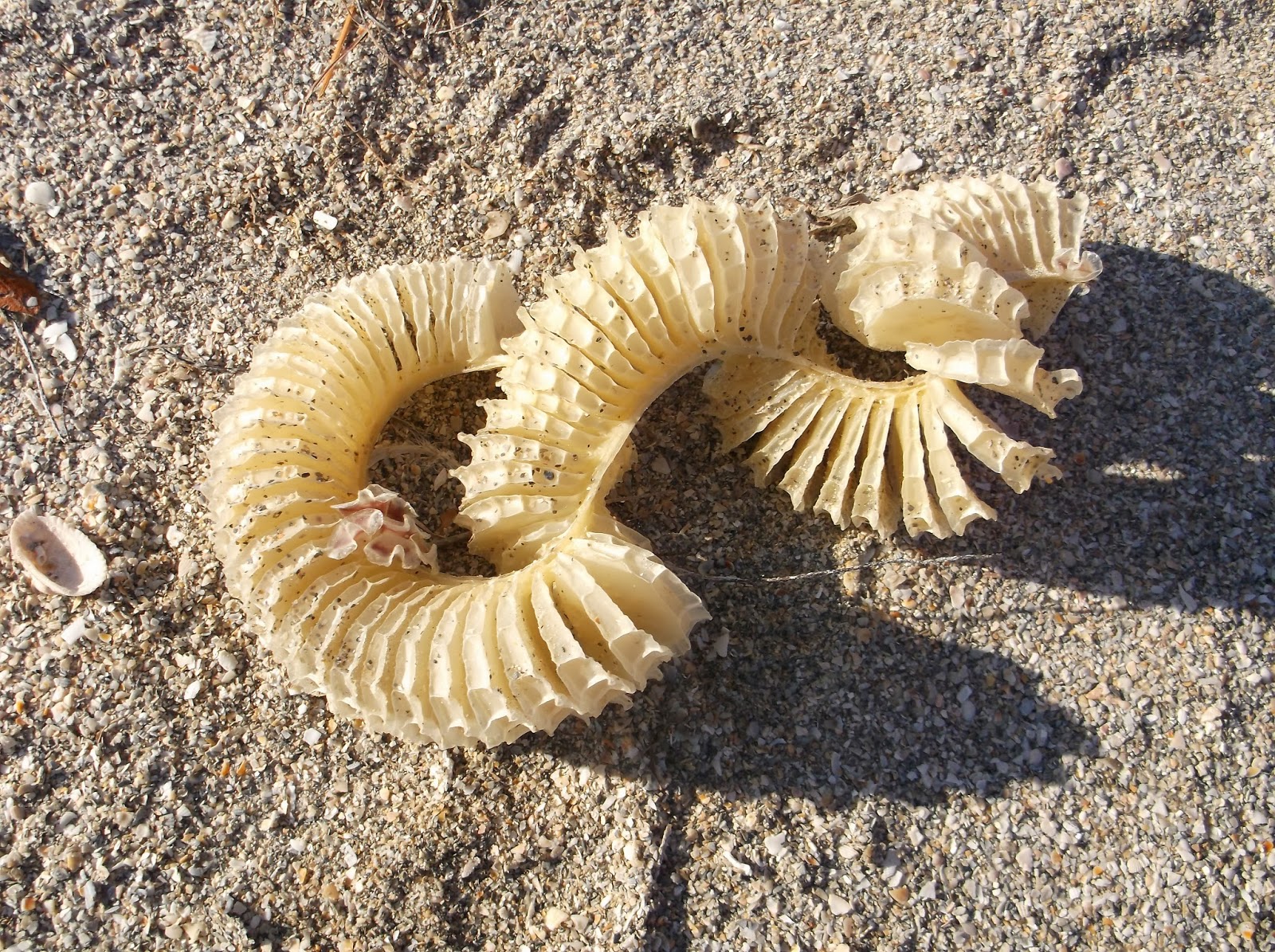
Whelk egg case
Internally fertilized eggs are surrounded by a transparent
mass of albumen, a gel-like material, and are laid in protective flat, rounded
egg capsules joined to form a paper-like chain of egg cases, commonly called a
"Mermaid's Necklace".
American Oystercatcher
With its highly contrasting dark and white plumage, it is
among the largest of North American shorebirds, measuring up to 18 inches in
length, and weighing 21 ounces, with a 32-inch wingspan.
Brown Spiny Sea Star
Can often be found in the open because it seeks light.
Commonly found in South and West Florida and Alabama.
A blob...
Not quite sure what this is. I'm thinking it is mesoglea,
the layer of gelatinous material that separates the inner and outer cell layers
of jelly like critters
On the north beach, the crashing waves left a rippled effect
on the sand. Other than my time spent in the desert, I've never seen rippled
sand like this before.
For the past month and a half, I have been quite busy. I
moved from Wisconsin to Illinois, went on an 8-day dog sledding/cross
country skiing expedition in northern Minnesota, and am currently in the process
of planning a trip to see my aunt and uncle in FL. Today’s post is going to
focus on an overview of my trip to Minnesota.
On January 18th, at 8:05am, I boarded a plan in
St. Louis, MO and was on my way to my final destination…Ely, MN. A few months back,
I learned about a veteran program by Outward Bound offering vets, free of charge, adventure trips all over the United States. On these trips Vets have the opportunity to "take part in wilderness expeditions that are physically, mentally and emotionally challenging in order to build the self-confidence, pride, trust and communication skills necessary to successfully return to their families, employers and communities following wartime service. These expeditions purposefully scaffold wartime experiences (carrying heavy packs, sore shoulders, rubbery legs, sleeping out, strange noises, sweat, dirt, frustration and anger) with authentic achievements to create positive emotional and mental outcomes."
I was stoked about the trip, but, I didn't quite know what to expect. The course description stated hard work was to be expected but I thought to myself...Why would being pulled on a sled by dogs be hard work? I arrived at the Voyager Outward Bound base camp late into the evening on the 18th, was issued a bunch of gear and warm clothes to keep me warm during the 6 days we would be eating, sleeping, and traveling over frozen lakes within the Boundary Waters Canoe Area, and then went to bed in an unheated bunk house. I followed the guide to the bunk house, along with five other vets who were on the expedition with me. "Time to get use to sleeping in the cold," the guide said before shutting off the lights.
We woke up the next morning, ate breakfast, and got a crash on packing dogsleds and proper handling of the dogs. We were on the ice ready to start our cold, winter adventure by lunch.
On our team we had a total of 12 dogs, 6 vets, and 2 guides. Each dog sled team was made up of 6 dogs and 2 mushers. 4 people at any given time were without a ride so they were responsible for cross country skiing in front of the sleds, breaking a trail through the soft, deep snow.
Once we got to camp, the fun ended and the hard work began. We had to break a hole through the thick ice so we could have water for cooking, drinking, and hydrating the dogs. We had to collect and process enough wood for making dinner, breakfast, and keeping us warm while we dried out our wet or frozen gear. And finally, we had to set up our tent.
When morning came, we had to break down camp, feed the dogs, load the sleds, and do our best to hide our presence by covering the ash from the fire with snow, sprinkle fresh snow over the imprint of our tent, and relocate a night's worth of dog poop deep into the woods. According to Leave No Trace principles, one should leave as little impact as possible so others can enjoy natures beauty. If you would like to learn more about the Leave No Trace principles click here.
If you've been watching the news lately you already know that winter is upon us in a very serious way. In the northern states, it's not one of those 50 degree, t-shirt wearing winters...it's an ice covered tree, snow past your past your ankle, wind chills below 0 degrees type winters.
Recently a few hikers attempting a 10 day hike through Great Smokey Mountain National Park had to be rescued after day one of their 10 day trip. (Click here to watch a video of the hikers recount their rescue on the Appalachian Trail) These three hikers did not make it to their first shelter and were forced to spend the night in the snow. I have never been in a situation like this and I hope I never will. If you watched the video, you know by now that these men had no backup shelter, were only a few miles away to their intended shelter, and burned their spare clothes for warmth. I know I would have done things differently if I were them and I bet you are saying the same thing too...
Through research and personal experience I've learned a few tricks to staying warm on a cold night.
1. Heat up 1 liter of water and pour it into a Nalgene. Bundle up in sleeping bag and place Nalgene in sleeping bag (typically by feet). On a really cold night, I went to bed with 2 warm Nalgenes bottles, one by my feet and one by my stomach as I curled up in the fetal position around it.
2. Do jumping jacks before getting into sleeping bag. Or do sit-ups while in sleeping bag. It doesn't really matter what you do, just as long as it gets the heart pumping and the blood flowing.
3. Eat something! The human body needs to burn calories in order to produce heat.
4. Get comfortable with wearing layers. The days of wearing heavy, bulky jackets and pants are nothing more than a distant memory. If the term base layer, insulation layer, or shell confuses you, watch this quick video on the basics of layering.
5. While I am on the subject of clothes...Put on more clothes. Extra clothes does no good if it is balled up in your stuff sack. While hiking in the Smokies this spring, the temp dropped and to stay warm one night I resorted to wearing everything in my backpack to bed.
6. If you own a down sleeping bag, do not cover your head with the sleeping bag. As you exhale you will create moisture, leading to a wet spot on your sleeping bag.
7. Check weather forecasts for the area where you will be hiking/spending the night...not the closest town 20 miles away and 3000 feet below. To check the weather forecast at shelters on the AT click here. The link will provide you a week long forecast from NOAA.
8. This one should be obvious...cover your head. A lot of body heat is lost through your head.
9. Get to know your neighbor. On cold nights, I like sleeping in the shelter so I can curl up between two people and absorb their body heat.
10. Do not put one of those emergency bivy bags over a down sleeping bag and go to bed. I did this once...It was great for about six hours but without thinking about all the condensation that will be trapped inside of the bivy, I woke up at 4AM in a soaking wet sleeping bag, freezing my bum off.
There are many more ways to stay warm on a cold night. Use any of these 10 tips as a starting point.
I had two cantaloupe slowly rotting in my kitchen and it got to the point where they started getting soft and mushy. Due to the holidays I completely forgot about them...I can't quite remember when I bought them! I figured I better get them in the dehydrator before it was too late. To fill up the rest of the trays, I added three sliced sweet potatoes.
For the sweet potatoes, I tried to cut them up as even as possible. The recipe I was using said to peel the potatoes, slice them up at an 1/8 inch, soak them in warm water for ten minutes, drizzle oil on them and add salt. Have you ever tried slicing a rock hard, raw potato before; it's difficult! I hard such a hard time cutting the potatoes; I even slipped but luckily the knife blade cut into my fingernail (thankfully not my flesh!). After dehydrating them at 350 for 12 hours, they turned out okay. I could taste to rawness of the potato...maybe next time I will cook them to reduce the starchy taste. My ma loved them so these will not be added to my bird food :)
Beside having issues with cutting my potatoes, I had melon issues as well. After quartering my cantaloupes, I decided that one was way too soft and juicy to slice up, so, I turned it into a puree. My intent was to make a fruit leather...instead I made a dry bitter orange mess. It was gross! The sliced cantaloupe turned out crispy and sweet, making the dehydrating attempt not a total loss.
Overall, I would call this dehydrating attempt a rank just below a success...not quite a failure but not quite a success...is there a word for that?
January- Started a job as a ski lift attendant in order to pay for the gear I still needed for my Appalachian Trail thru-hike.
March- Rode the Amtrak for the first time. I decided to take the Amtrak from Wisconsin to Georgia because it was 1/2 the cost of an airplane ticket.
March 22- Made it to the top of Springer Mountain and hiked to Hawk Mountain shelter.
Late April- Left the trail and took a shuttle to Asheville TN so I could catch a Greyhound back to Wisconsin. I returned back to Wisconsin and moved into my ma's house, hoping to have a new job and be gone by August.
Summer- Spent the summer with my nieces and nephews. Didn't do too much out of the ordinary. I saw a lot of movies at the local theater ($3 tickets!). Found out soo many entry level jobs require a bachelor's degree...started thinking about finishing my 4 year degree in ecology.
September- Still at my ma's house, unfortunately. Started a new seasonal job in a dusty warehouse. My nasal cavities became polluted :(
November- Still couldn't find a permanent full time job so I planned to save as much money as I could and go hiking on the AT. Maybe I would turn my failed thru-hike into a successful section hike.
December- Applied for a bunch of National Park Service jobs in all corners of the US and even for a position in Guam. Agreed to take a position in IL...no more hike for me...maybe in 2015!
Except for the one month I was on the trail, this was a very uneventful year.
I am grateful for the time I got to spend with my family. I got to see them twice in one year (family reunion and Christmas)! For not being around since 2010, spending time with family meant a lot, because, I don't know how much longer I will be in the Midwest.
If I had to do one thing over, I would not have stayed at my ma's house. I've learned that no matter how old I get, she will treat me like an child. Maybe this is how all parents act...I'm not quite sure. I do know, after living on your own for so long, it's difficult to have someone come into your life and micromanage your actions.
A fresh start is needed, and, that is exactly my plan for 2014. This weekend, I am moving to my new apartment in Illinois. Here' s to making 2014 a great year!!!